
Amazon SES Review For 2026:
Is This Email Infrastructure Right for You?
Amazon Simple Email Service (SES) has become the default choice for developers needing raw email infrastructure at scale.
With its rock-bottom pricing of $0.10 per 1,000 emails and the backing of AWS’s massive infrastructure, it processes over a trillion emails annually.
But as businesses discover, having access to powerful infrastructure and actually being able to use it effectively are two very different things.

Table of contents
To create this Amazon SES review, I’ve analyzed the platform. While Amazon SES excels as a bare-metal email utility for technical teams, its sandbox restrictions, strict suspension policies, and minimal marketing tools create significant barriers for many businesses.
This is where platforms like Emercury offer a fundamentally different approach: providing dedicated deliverability expertise alongside reliable SMTP relay services for transactional emails, all without the technical complexity or stringent requirements that make Amazon SES challenging for many organizations. For businesses that also need marketing capabilities, Emercury’s Marketing Manager product offers a complete solution.
Emercury addresses the exact pain points that frustrate Amazon SES users through a performance-focused approach. With deliverability support across all paid tiers, easier SMTP relay acceptance without requiring registered entity status, human support instead of documentation-only assistance, fair pricing that charges for sends rather than gating features, and a platform designed for ease of use, Emercury provides an accessible alternative for businesses that prioritize email performance and deliverability over convenience features.
That said, Emercury isn’t for everyone. If you need virtually unlimited scale, deep AWS ecosystem integration, or the absolute lowest per-email cost, Amazon SES may still be the better fit. But for businesses seeking reliable delivery with expert support and simpler acceptance criteria, Emercury’s SMTP Relay offers compelling advantages.
If you’re looking for email infrastructure with dedicated deliverability support that works with your business rather than against it, you can explore Emercury’s platform here.
What is Amazon SES?
Amazon Simple Email Service launched in January 2011 as AWS’s solution to email infrastructure challenges. Amazon built sophisticated email infrastructure to serve its own large-scale customer base and commercialized this internal system to offer the same scalability and reliability to external developers.
 Today, Amazon SES operates as a cloud-based email sending service that provides API and SMTP access for sending emails. What many describe as a “bare-metal” approach to email reflects its positioning: a developer utility with minimal interface and maximum control. It integrates deeply with other AWS services, enabling complex automated workflows through Lambda functions, S3 storage, and CloudWatch monitoring.
The service attracts SaaS platforms sending millions of system notifications, technical startups with developer resources who want to minimize costs, high-volume senders needing significant price advantages over traditional ESPs, and agencies building white-labeled email platforms on top of SES infrastructure. It’s designed for teams that can build their own email management tools and prefer infrastructure over interface.
Amazon SES Pros & Cons
|
Pros |
Cons |
|---|---|
| ✅ Unbeatable pricing at $0.10 per 1,000 emails | ❌ Steep learning curve requiring technical expertise |
| ✅ Massive scalability on AWS infrastructure | ❌ Strict suspension policies with manual appeals |
| ✅ Deep AWS ecosystem integration | ❌ Limited native marketing features |
| ✅ Virtual Deliverability Manager for reputation | ❌ Support requires paid AWS plans |
| ✅ Mail Manager for enterprise routing | ❌ Complex setup (DKIM, SPF, DMARC) |
| ✅ Configuration Sets for traffic segmentation | ❌ Sandbox restrictions limit initial testing |
Amazon SES Review: How it Works & Key Features
Bare-Metal Email Infrastructure
Amazon SES provides exactly what it promises: raw email sending capability.
Users interact primarily through APIs or SMTP endpoints, with the AWS Console offering basic configuration rather than campaign management. The service handles both transactional messaging (password resets, order confirmations) and bulk sending, though it includes API-based templates rather than visual builders found in marketing platforms.
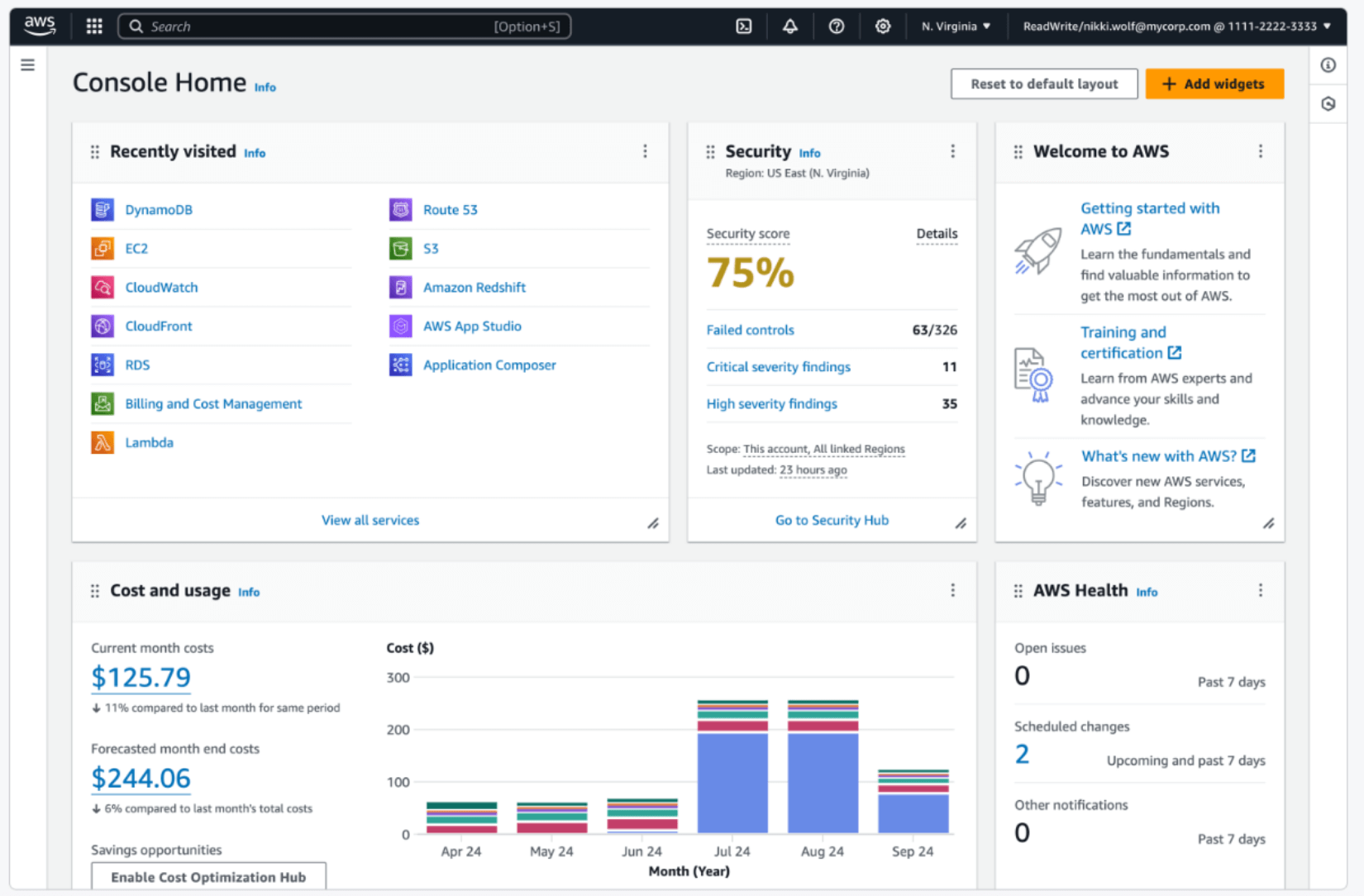 The platform operates on a quota system. New accounts start in a restrictive “Sandbox” mode, limited to 200 emails per day sent only to verified addresses. Exiting the sandbox requires submitting a detailed request explaining your use case, website, and compliance procedures. Once approved, quotas typically start around 50,000 emails per day with 14 emails per second, though actual limits vary based on your specific use case and can scale based on reputation and request.
Setup involves verifying domains or email addresses through DNS records, configuring DKIM for authentication, setting up SPF records, and optionally implementing DMARC policies. The console provides verification status but assumes users understand these protocols. There’s no hand-holding; you either know how to configure MX records and CNAME entries, or you’re stuck reading documentation.
Virtual Deliverability Manager
The Virtual Deliverability Manager (VDM) represents Amazon’s attempt to make deliverability less opaque. It provides dashboards showing delivery rates, bounce rates, and complaint rates broken down by ISP. The system includes Advisor recommendations for fixing authentication issues and Dashboard visualizations of engagement metrics.
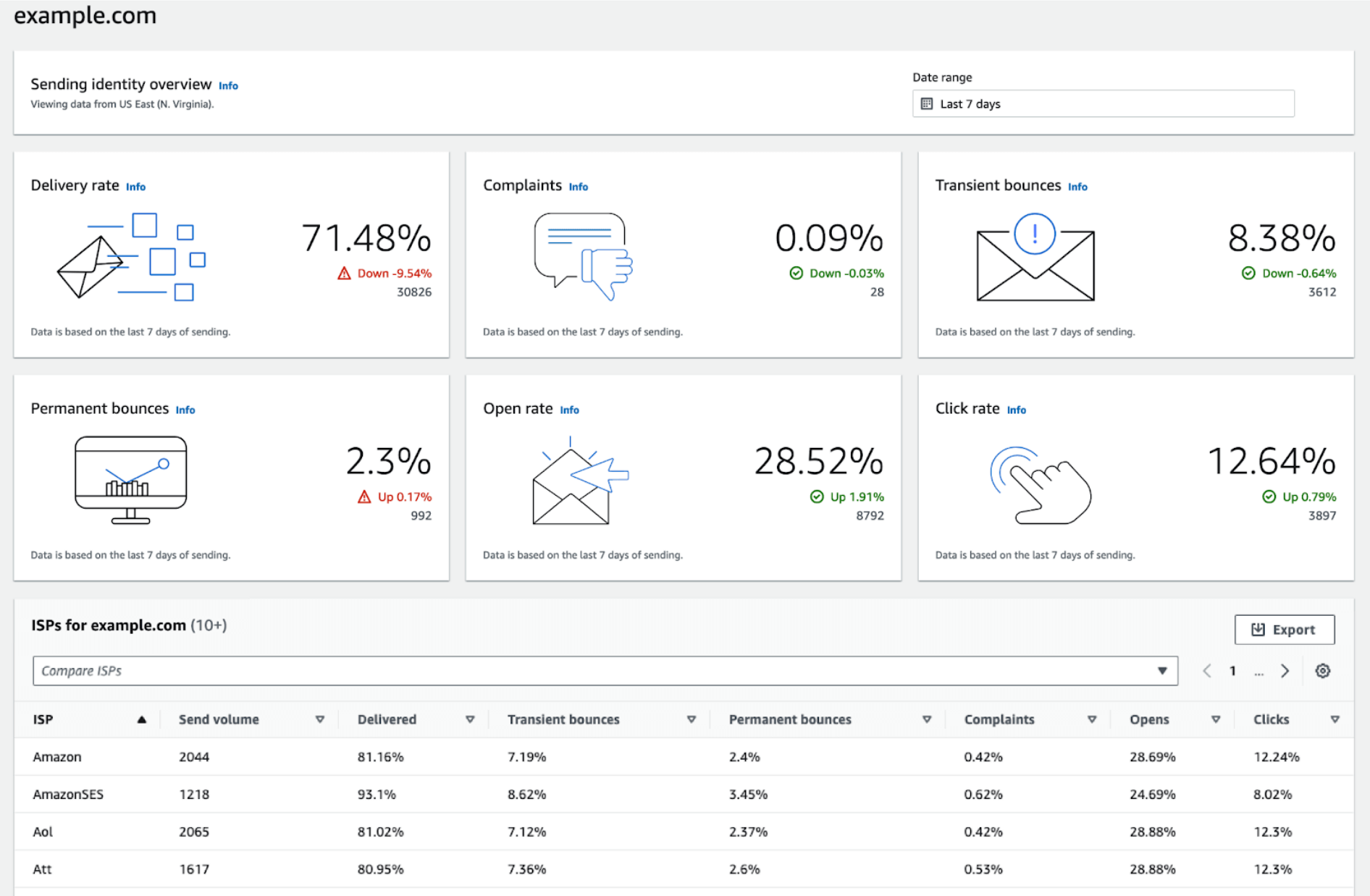 The standout feature is Optimized Shared Delivery, which automatically chooses optimal IPs when sending emails to improve delivery to recipients. Rather than randomly assigning shared IPs like some competitors, VDM’s system is designed to enhance deliverability through intelligent IP selection.
However, VDM is a paid add-on with volume-based pricing:
- $0.07 per 1,000 emails for volumes under 10 million monthly,
- $0.05 per 1,000 for 10-100 million,
- and $0.02 for volumes over 100 million.
For smaller senders, this increases the total cost by 70%, from $0.10 to $0.17 per 1,000 emails.
Configuration Sets and IP Management
Configuration Sets allow users to group emails for tracking and apply specific rules. Acting as labels for email streams, they enable reputation isolation between different types of traffic, detailed analytics per campaign or use case, and event publishing to CloudWatch, SNS, or Kinesis.
Users can create up to 10,000 Configuration Sets, applying them via headers (X-SES-CONFIGURATION-SET) or API parameters. This lightweight approach provides an alternative to the sub-account requirements some competitors use for traffic isolation.
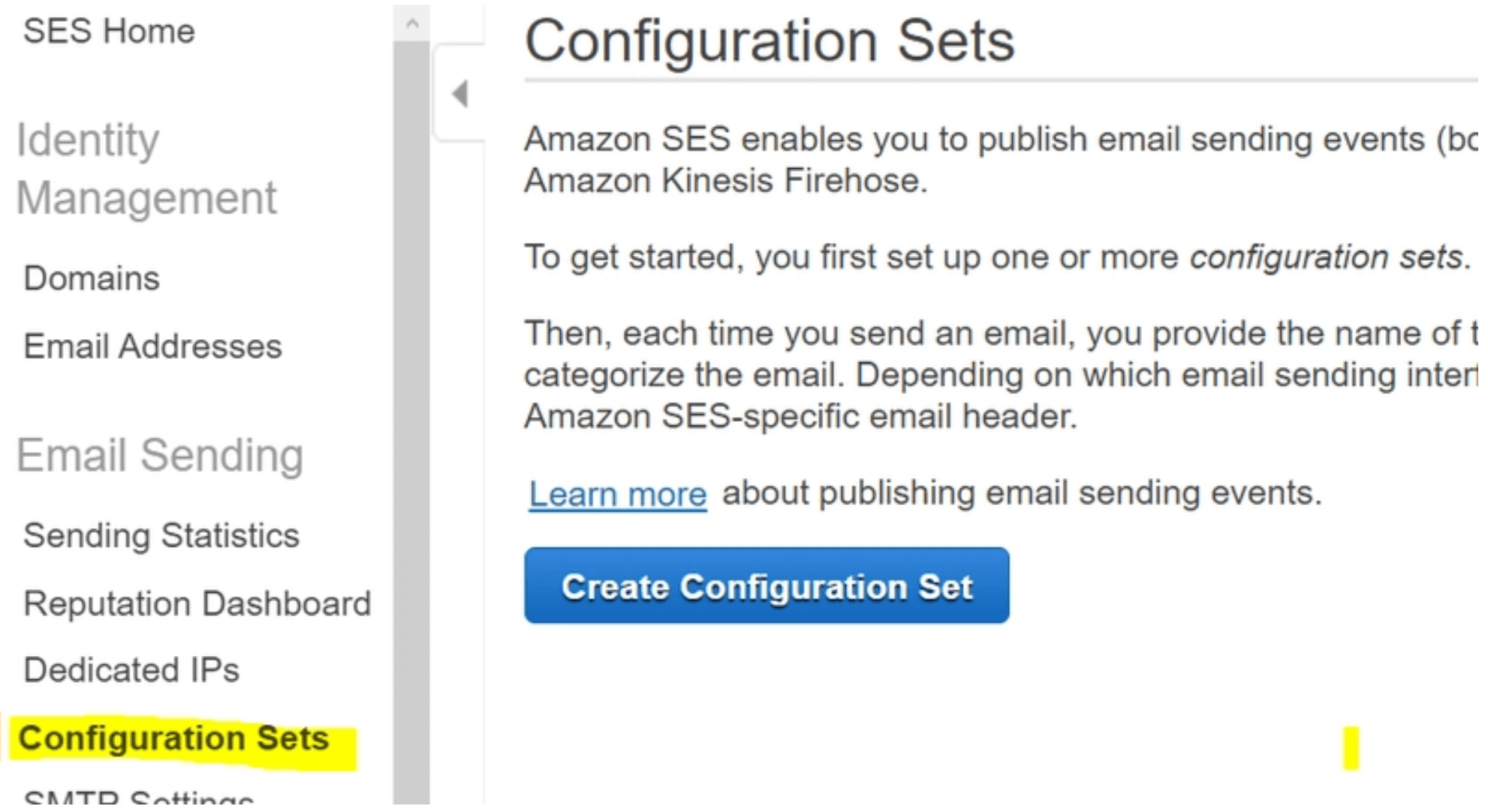 Source: DEV Community
IP management options include shared IPs (default), standard dedicated IPs at $24.95 per IP monthly, and managed dedicated IPs that auto-scale based on volume. The managed option charges $15 monthly plus usage fees but handles warming and scaling automatically, features that many high-volume senders find valuable for operational efficiency.
Mail Manager for Enterprise Routing
Mail Manager, launched in 2024, provides email gateway capabilities for complex enterprise needs. It creates ingress endpoints for receiving mail, applies traffic policies and rules, and routes messages to various destinations including S3, internal servers, or back to the internet.
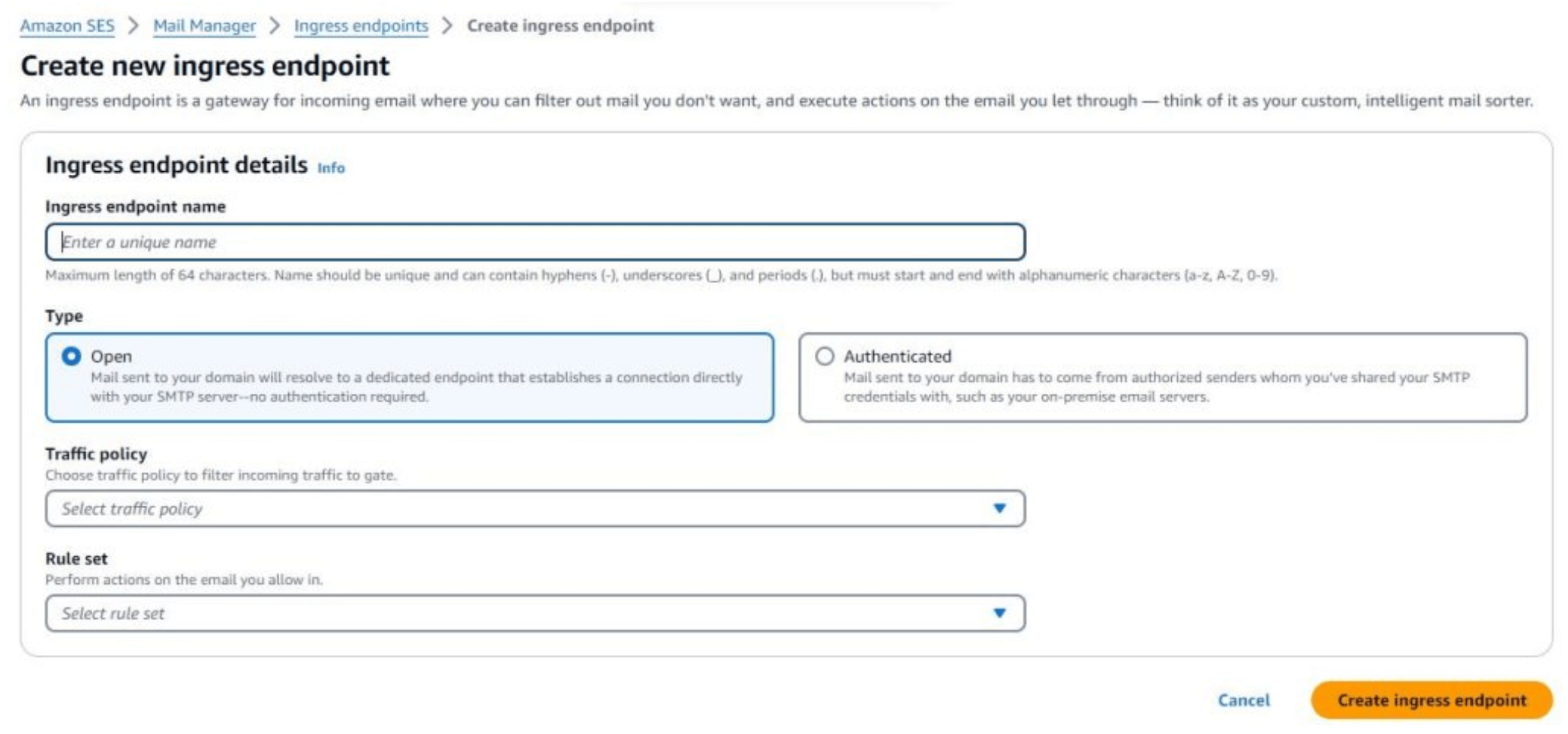 The system supports both open endpoints for public mail reception and authenticated endpoints for internal traffic. But the pricing adds complexity:
- Open ingress endpoints: $50 per month
- Processing: $0.15 per 1,000 emails
- Archiving: $2 per GB ingested and $0.19 per GB per month for storage
Add-ons from partners like Trend Micro, Abusix, and Spamhaus integrate directly, though each incurs additional per-analysis charges. While powerful for enterprises needing email gateway functionality, Mail Manager’s complexity and cost structure may be excessive for standard sending needs.
Where Amazon SES Falls Short
While Amazon SES excels at providing raw infrastructure, several limitations reveal a platform optimized for technical teams over business users.
Acceptance and Suspension Barriers: The sandbox exit process creates an immediate barrier, requiring detailed justification that Amazon may reject. Requirements include being a registered entity and meeting specific sending thresholds. Even approved accounts face automated suspension for bounce rates exceeding 5% or complaint rates over 0.1%. The appeal process, while officially promising an initial response within 24 hours, often involves longer waits for full resolution, with users reporting week-long disruptions during manual review.
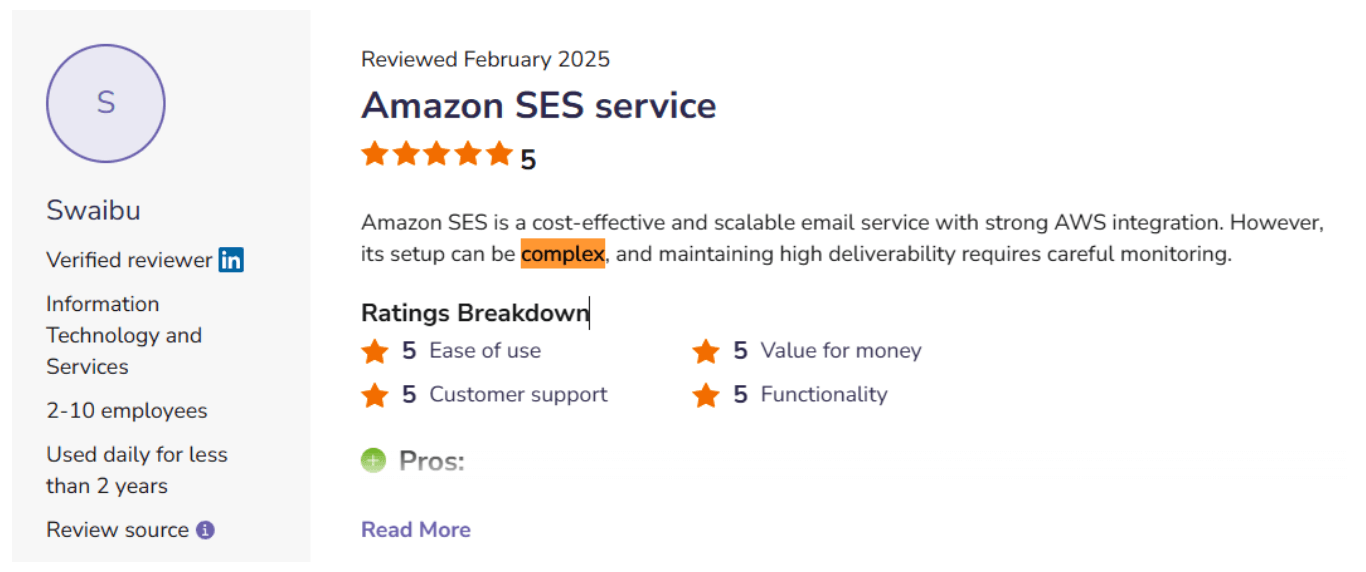
Technical Complexity Without Visual Tools: SES assumes deep technical knowledge. While it provides API-based templates and contact list management capabilities, there’s no visual email builder, no drag-and-drop interface, and no campaign scheduling. Everything requires code or API calls. While this appeals to developers, it excludes marketing teams and small businesses without technical resources.
 Source: Software Advice
Limited Marketing Capabilities: SES provides basic subscriber management through its contact list APIs, but lacks the sophisticated marketing functionality found in dedicated platforms. No automation workflows, no A/B testing built-in, no advanced segmentation tools, no visual journey builders. Users must build these capabilities themselves or add Amazon Pinpoint, increasing complexity and cost.
Support Behind Paywalls: Basic AWS support covers only billing issues. Technical help requires paid Developer support starting at $29 monthly or Business support at $100 monthly minimum. For a service marketed on low cost, mandatory support fees for basic assistance affect the overall value proposition.
Source: Reddit
Throttling and Scalability Management: Despite AWS’s scale, users report frequent throttling issues. The per-second sending limits require careful queue management, and sudden volume spikes can trigger automatic restrictions. While brief bursts above the maximum send rate are allowed, sustained spikes cause throttling or message rejection, requiring careful traffic management.
These limitations reflect Amazon’s infrastructure-first philosophy, but they create clear opportunities for platforms that prioritize accessibility, deliverability expertise, and business needs alongside technical capability.
Top Amazon SES Alternative: Emercury’s SMTP Relay
Emercury addresses Amazon SES’s limitations through a performance-focused platform that provides deliverability expertise across all paid tiers. The company, with origins tracing back to around 2006-2009, evolved from an internal lead generation tool into a comprehensive solution specifically designed for businesses that prioritize email performance and deliverability over convenience features.
What sets Emercury apart from Amazon SES is its SMTP Relay product, which offers the transactional email infrastructure developers need without the barriers that make Amazon SES challenging. For businesses that also require marketing capabilities, Emercury offers a separate Marketing Manager product, ensuring clear separation between transactional and marketing emails for compliance and optimal performance.
Deliverability Support Across All Paid Tiers
Where Amazon SES leaves users to figure out deliverability alone (or pay extra for VDM dashboards), Emercury’s primary differentiator is its deliverability support included across all paid plans.
The level of support scales with your tier: Starter and Grow plans receive chat access to customer success representatives with delivery expertise who can help troubleshoot issues and optimize performance. Pro and Scale plans include dedicated Delivery Analysts who actively monitor reports, check domain health, track spam complaints, identify blacklisting issues, and investigate performance changes.
These aren’t just support agents reading scripts. Emercury’s delivery experts proactively investigate problems like sudden drops in delivery rates and stay current with policy changes from major providers like Google and Yahoo. All paid plans include access to deliverability expertise, with the depth of support scaling by tier.
 The platform’s domain trending reports analyze the health of sending domains, displaying metrics on sending history, current domain health, spam complaints, and overall sender reputation. Critically, the system supports monitoring multiple domains simultaneously, which is valuable for customers who distribute volume across 15–20 sending domains to optimize deliverability.
SMTP Relay: Developer-Friendly Without the Red Tape
Emercury’s SMTP Relay directly addresses Amazon SES’s barriers.
Unlike Amazon’s stringent requirements, which include registered entity status, specific sending thresholds, and sandbox restrictions, Emercury provides straightforward access with simpler acceptance criteria and clear usage guidelines.
The SMTP relay, designed exclusively for transactional emails, handles 3,000 emails monthly on the free tier, with paid plans scaling up to 100 million emails per month on the highest tier. Authentication uses standard SMTP credentials, integrating easily with any application or framework. The platform emphasizes “no throttling during critical campaigns,” addressing a common Amazon SES frustration.
 Acceptable transactional emails include account registration confirmations, password resets, customer service messages, webinar submission replies, welcome/onboarding emails (without marketing offers), order/shipping confirmations, and form submission replies. The system is particularly optimized for SaaS communication enablement, as SaaS platforms generate multiple transactional emails per user, making reliable delivery critical.
Important: Marketing emails cannot be sent through the SMTP relay, as this violates Emercury’s terms and may result in account action. All marketing communications must be sent using the Marketing Manager product.
Human Support vs. Documentation-Only
One of the starkest differences between Emercury and Amazon SES is the support experience. Amazon SES operates on a documentation-only model for free users, with technical assistance locked behind paid AWS support tiers starting at $29/month.
Emercury takes the opposite approach with human support available across all paid plans. Rather than leaving users to search through documentation or forums, Emercury provides direct access to support staff who understand email deliverability. This human-first approach means faster resolution of issues and guidance tailored to your specific situation.
Marketing Manager: For Those Who Need Both
For users who need marketing capabilities beyond transactional emails, Emercury’s Marketing Manager provides comprehensive tools as a separate product. This clear separation ensures compliance and optimal performance for each use case.
The Marketing Manager is designed for performance-focused email marketers, including email marketing veterans focused on ROI, affiliate marketers and lead generators, personal brands and newsletter owners monetizing through ads, and businesses in verticals that traditional platforms often avoid.
The platform includes AI-powered content generation tools that enable faster workflow efficiency. Users can generate email copy, subject lines, and mobile-optimized images directly within the platform. These AI tools streamline campaign creation and support faster iteration when setting up A/B split tests, making it easier to test multiple variations without starting from scratch.
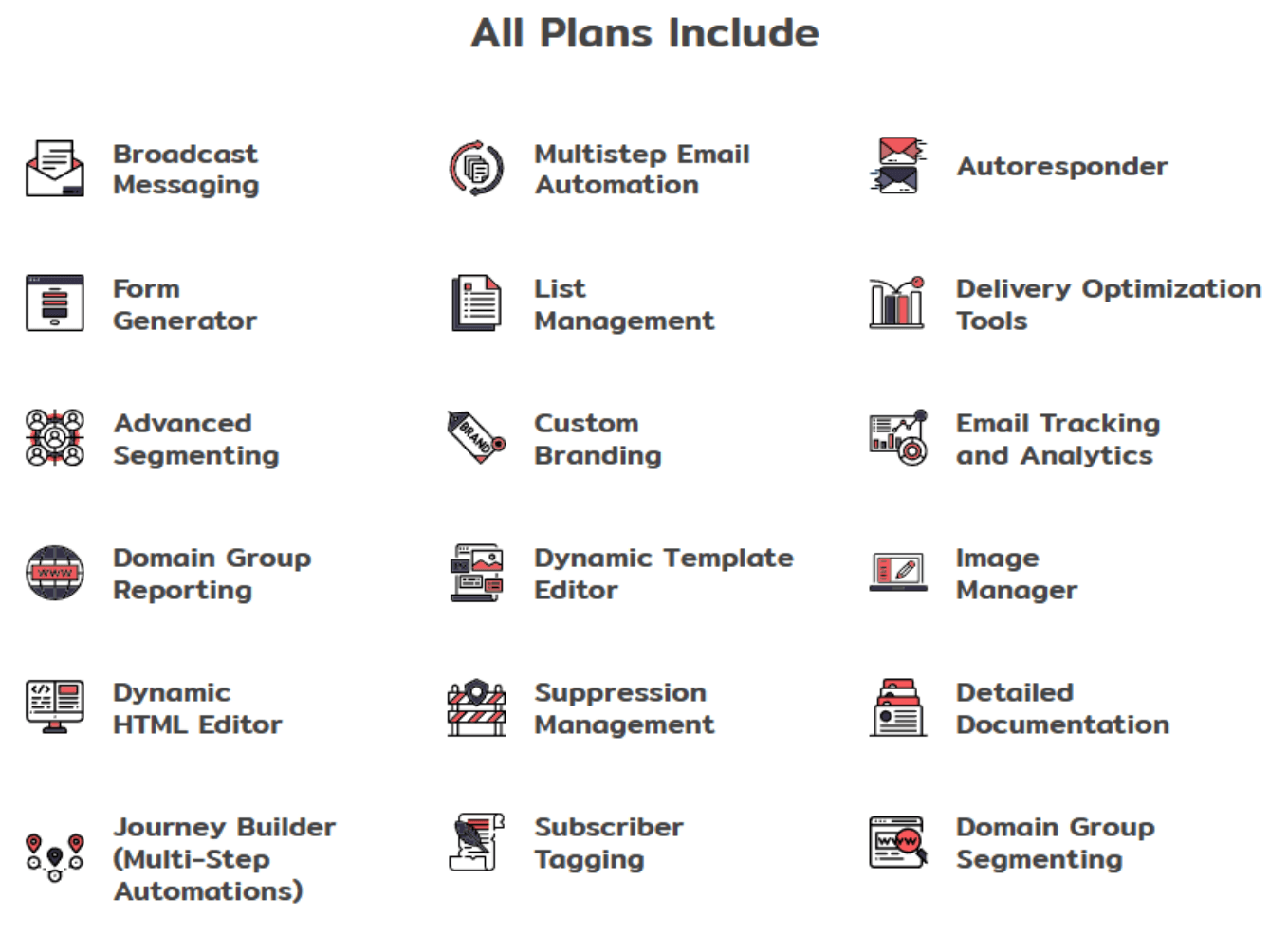
The Journey Builder enables visual automation workflows with drag-and-drop simplicity, allowing complex sequences with conditional branching, wait steps, and tag-based actions without code. The platform also includes responsive email editors, campaign broadcasting with A/B testing (Grow plans and above), list management with advanced segmentation, form generators, and comprehensive reporting including eCPM tracking for affiliate marketers.
Advanced List Hygiene and Content Optimization
Emercury’s list analysis tool performs verification-based checks that Amazon SES doesn’t provide. It identifies bogus emails, spam traps listed in databases, and unsafe addresses that could trigger spam reports. The tool provides clear metrics showing safe-to-send versus should-remove emails, helping prevent blacklisting and maintain healthy deliverability rates.
The content scoring engine is a one-click feature that scans email copy and analyzes syntax, word choice, and spam trigger words. It predicts inbox versus spam folder placement and provides recommendations to modify flagged content before sending. The engine performs thorough backend checks while maintaining a simple interface.
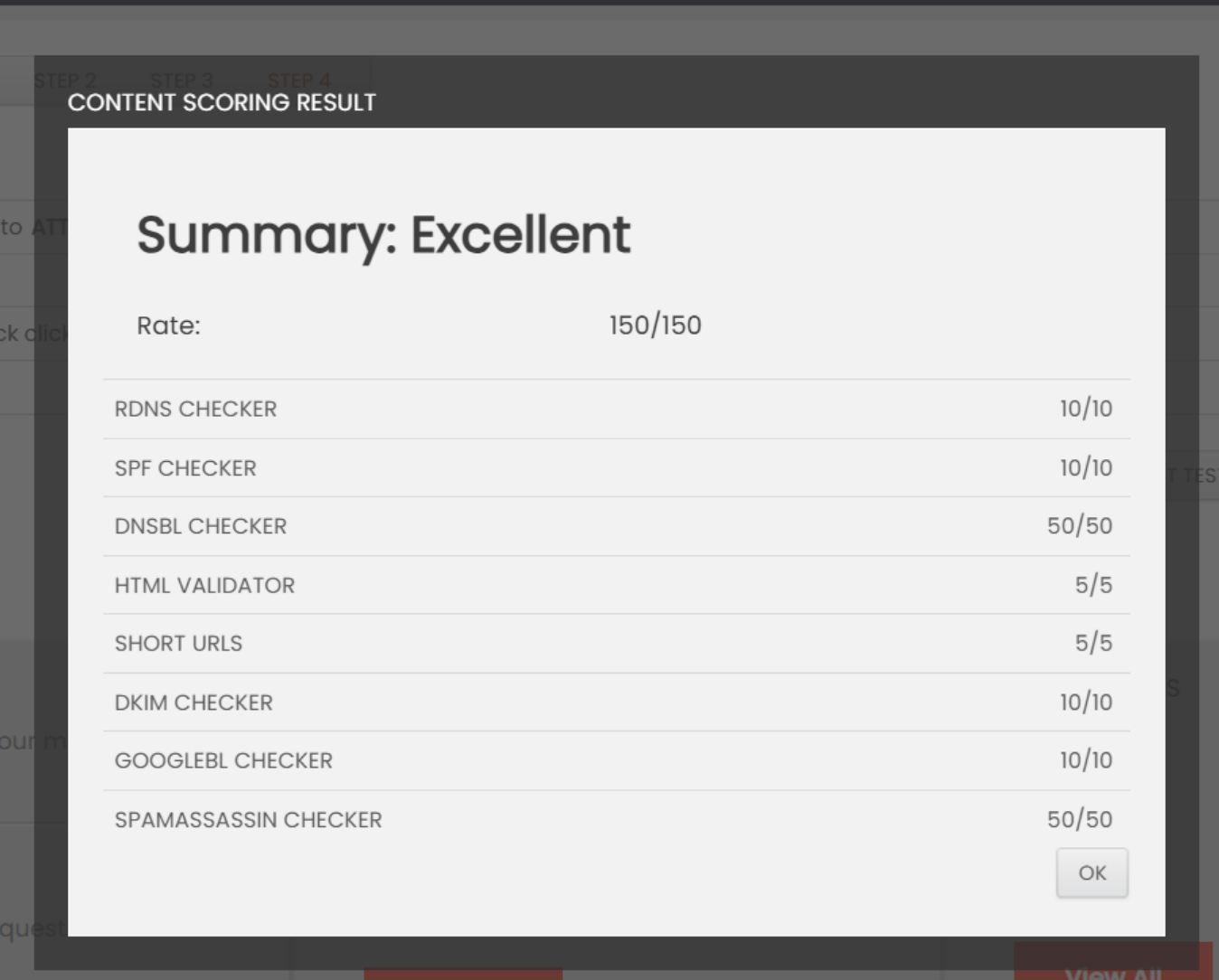 These tools reflect Emercury’s performance-first philosophy: it’s for customers willing to invest in proper email practices to achieve measurable results, not those wanting two or three clicks to send and hoping for the best.
Fair Pricing Without Feature-Gating
Amazon SES’s pricing model, while low per-email, becomes complex when you add VDM ($0.07/1,000), dedicated IPs ($24.95/month each), Mail Manager costs, and mandatory support tiers for technical assistance.
Emercury takes a different approach with fair pricing that charges for sends rather than gating features behind tiers. Core deliverability tools and support are available across all paid plans rather than reserved for enterprise negotiations. Pricing models include both subscriber-based and CPM (cost per thousand) options. The CPM model charges strictly for emails sent with no limit on contacts, allowing management of large lists without paying for inactive subscribers.
While Emercury’s per-email cost is higher than Amazon SES’s baseline $0.10/1,000, the included deliverability support and simpler pricing structure often result in better overall value for businesses that factor in the true cost of email operations.
Built for Industries Others Avoid
Emercury specifically caters to senders in industries that other platforms often avoid. The platform explicitly welcomes affiliate marketers and lead generators, provided content is legitimate and compliant. This positioning attracts businesses in financial services, insurance, loans, home insurance, college consultancy, and other sectors often considered higher-risk by traditional ESPs.
Unlike competitors who claim affiliate support but shut down accounts when volume increases, Emercury honors its commitment: as long as recipients have given consent and content complies with terms and conditions, customers can continue sending. Prohibited content includes adult content, gambling, and fraudulent activities, but most other verticals are supported.
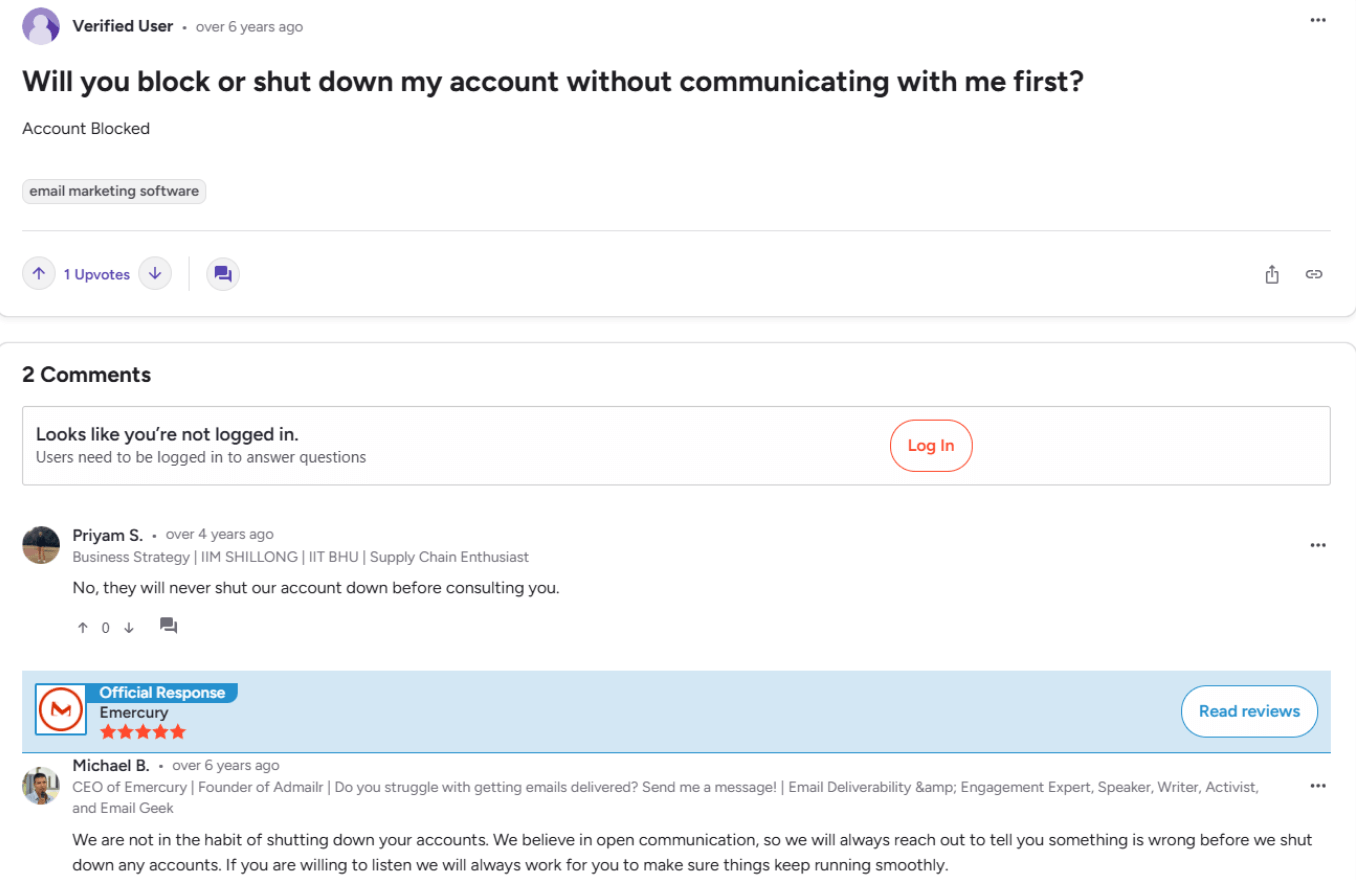
The platform doesn’t shut down accounts without cause, a major differentiator from Amazon SES’s automated suspensions. Instead of automated enforcement, Emercury takes a consultative approach to account management, providing guidance for improvement rather than surprise terminations.
 Integration Options
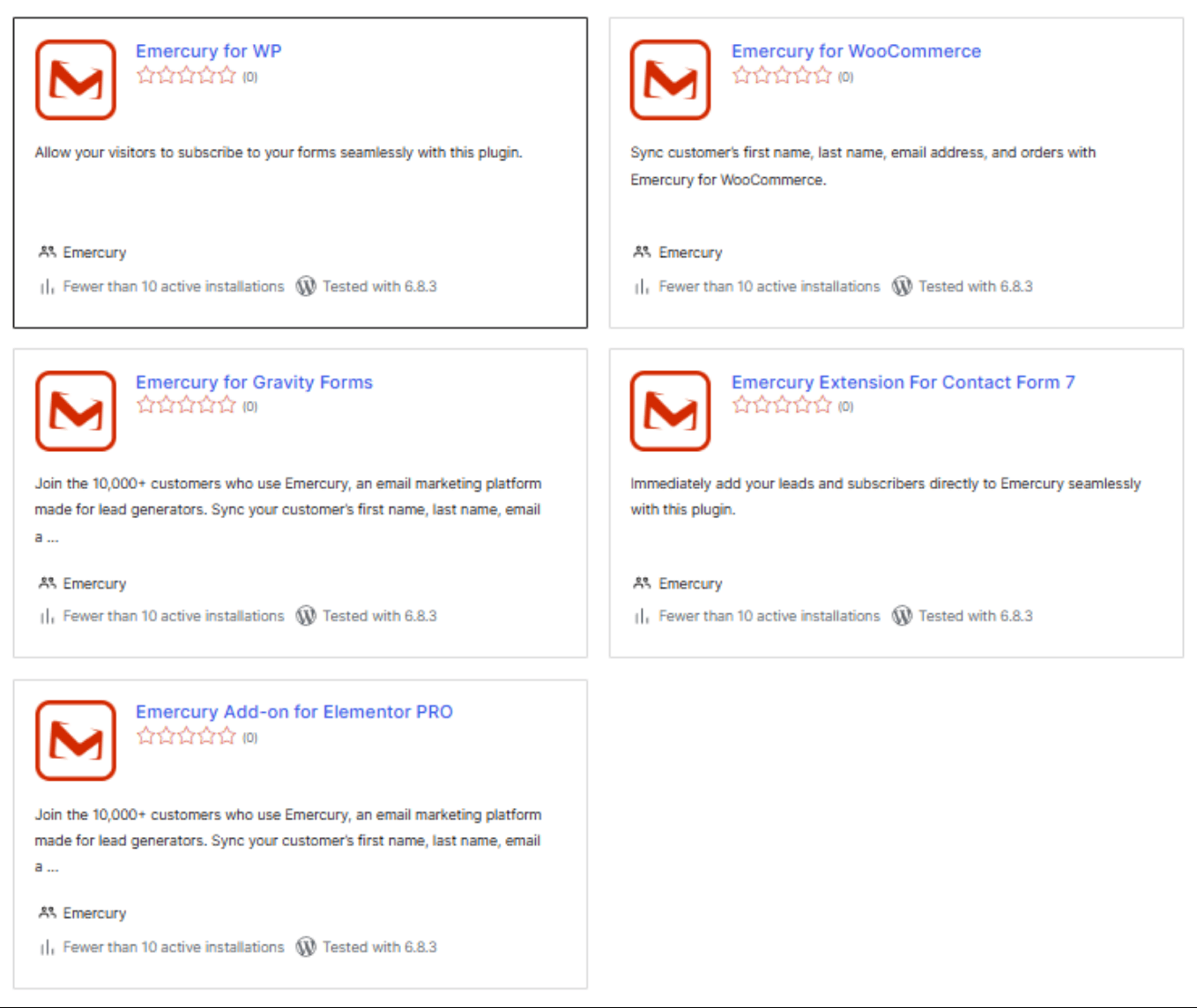
Integration capabilities include WordPress plugins, ClickFunnels forms integration, and Zapier support connecting to 2,000+ apps. A Woocommerce plugin is currently being revamped for enhanced e-commerce support. While Emercury doesn’t match AWS’s ecosystem breadth (a consideration for teams deeply invested in AWS infrastructure), it provides the integrations commonly needed for marketing and transactional email operations.
Amazon SES or Emercury: Comparison Summary
|
Amazon SES |
Emercury |
|
|---|---|---|
| Primary Focus | Developer infrastructure | Performance SMTP relay with deliverability support |
| Product Separation | ⭐⭐⭐ Single service for all email types |
⭐⭐⭐⭐⭐ Clear separation: SMTP Relay (transactional) & Marketing Manager (marketing) |
| Deliverability Support | ⭐⭐ Self-service with paid VDM add-on |
⭐⭐⭐⭐⭐ Deliverability support across all paid tiers (scaling with plan level) |
| SMTP Relay Acceptance | ⭐⭐ Registered entity required, sandbox process |
⭐⭐⭐⭐⭐ Simpler criteria, no entity requirement |
| Marketing Tools | ⭐⭐ Basic templates and lists |
⭐⭐⭐⭐⭐ Full automation, AI tools, journey builder (via Marketing Manager) |
| Technical Skill Required | ⭐⭐⭐⭐⭐ High (API/code focused) |
⭐⭐ Low (visual tools available) |
| Support Quality | ⭐⭐ Documentation-focused, paid technical support |
⭐⭐⭐⭐⭐ Human support with deliverability expertise |
| Suspension Approach | ⭐⭐ Automated enforcement (5% bounce, 0.1% complaint limits) |
⭐⭐⭐⭐⭐ Consultative management with guidance |
| Throttling Issues | ⭐⭐ Frequent throttling reported |
⭐⭐⭐⭐⭐ No throttling during critical campaigns |
| Affiliate/Lead Gen Policy | ⭐⭐⭐ Standard compliance required |
⭐⭐⭐⭐⭐ Explicitly supported with clear guidelines |
| Volume Capacity | ⭐⭐⭐⭐⭐ Virtually unlimited with scaling |
⭐⭐⭐⭐ Up to 100 million emails/month (lower than SES’s unlimited scale) |
| Domain Management | ⭐⭐⭐ Basic domain verification |
⭐⭐⭐⭐⭐ Domain trending reports, multi-domain support (15-20) |
| Ecosystem Integration | ⭐⭐⭐⭐⭐ Deep AWS ecosystem integration |
⭐⭐⭐ Standard integrations (Zapier, WordPress, ClickFunnels) |
| Pricing Model | ⭐⭐⭐⭐⭐ Lowest per-email cost ($0.10/1,000) |
⭐⭐⭐ Higher per-email cost but includes support and tools |
Final Verdict
The choice between Amazon SES and Emercury depends on your technical resources, deliverability priorities, and actual email needs.
Choose Amazon SES if:
- You’re a developer-led team building custom email infrastructure
- You have deep AWS integration requirements
- You need absolute bottom-dollar pricing
- You can handle technical complexity and deliverability challenges independently
- You need virtually unlimited scale beyond 100 million emails/month
- You don’t require marketing capabilities or dedicated support
- You are a SaaS platform or technical startup that views email as pure infrastructure
- You have the expertise to manage authentication, deliverability, and queuing yourself
Get started with Amazon SES today and take full control of your email infrastructure.
Choose Emercury if:
- You’re a performance-focused business that prioritizes deliverability and email performance over convenience features
- You need reliable SMTP relay services with simpler acceptance criteria than Amazon SES
- You want deliverability support included with your plan rather than self-service dashboards
- You prefer human support over documentation-only assistance
- You value fair pricing that doesn’t gate features behind enterprise tiers
- You require simpler SMTP relay access without entity requirements or sandbox restrictions
- You also need marketing capabilities (via the separate Marketing Manager product)
- You value consultative support over automated account suspensions
- You operate in industries like affiliate marketing that traditional platforms often avoid
Start your free trial* with Emercury today and maximize your email performance with expert support.*
At the end of the day, email isn’t just infrastructure for most businesses; it is a critical performance channel requiring both reliable delivery and expert support.
Emercury recognizes this reality, providing deliverability expertise across all paid tiers, clear product separation for compliance and optimization, human support instead of documentation-only assistance, and a platform designed for businesses that can’t afford to have their emails throttled, blocked, or lost in spam folders.
That makes Emercury’s SMTP Relay particularly compelling for:
- SaaS platforms and developers needing reliable transactional email delivery for communication enablement,
- businesses seeking simpler SMTP access without registered entity requirements or sandbox restrictions,
- email marketing veterans and ROI-focused businesses who understand deliverability’s value,
- and organizations in affiliate marketing, financial services, and other verticals that traditional platforms avoid.
For those who also need marketing capabilities, Emercury’s Marketing Manager provides a complete solution while maintaining clear separation from transactional email operations.